Organization Change Management Excellence
A structured approach to moving people, processes, and systems from a current state to a desired future state while keeping the business running smoothly.
Benefits of OCM
Success Rate Increase
Higher adoption and implementation success
Time to Adoption
Faster time to full adoption and ROI
Resistance Reduction
Lower employee resistance to change
ROI Improvement
Better return on transformation investments
Success Story: Plant Consolidation
See how strategic OCM ensured 98% employee retention during a major facility merger.
Organizational Change Management Excellence
Organizational change management (OCM) is a structured approach to moving people, processes, and systems from a current state to a desired future state while keeping the business running smoothly.
Strategic Alignment
Ensuring change initiatives align with business objectives and create compelling urgency.
Sustainable Transformation
Embedding change through updated policies, KPIs, and reinforcement systems.
Change Definition & Business Case
Clearly articulating what is changing and why it matters in business terms: cost, quality, safety, growth, or compliance.
Stakeholder Analysis & Mapping
Analyzing functions, sites, roles, and suppliers affected and mapping stakeholders using frameworks like Prosci ADKAR.
Leadership Engagement & Coalition
Identifying executive sponsors and forming cross-functional change networks to localize messages and surface issues.
Communication & Training Strategy
Developing two-way communication plans and targeted training programs for new processes, systems, and behaviors.
Why Change Management Fails (and How We Fix It)
Statistic show that nearly 70% of change initiatives fail to achieve their goals. The primary reason is not the technology or the process itself, but the people side of change. At MG Techworks, we understand that organizations don't change, people do. If your employees don't embrace the new ERP system, quality standard, or organizational structure, the investment is wasted.
Our Organizational Change Management (OCM) services are designed to bridge this gap. We don't just send out emails; we build coalitions of support. We identify and empower change champions within your workforce who can influence their peers essentially "selling" the change from the ground up.
By addressing resistance proactively and making the "case for change" personal and relatable, we ensure that your transformation projects deliver the promised ROI and sustainable long-term results.
Integrating OCM with Project Management
Effective OCM is not an afterthought; it is integrated directly into the project lifecycle. We align our 8-step OCM methodology with your project milestones. When the technical team is designing the solution, our OCM team is analyzing the impact on stakeholders. When the solution is being tested, we are conducting training and readiness assessments.
This integrated approach ensures that when you flip the switch on Go-Live day, your organization is ready. There are no surprises, anxiety is managed, and productivity dips are minimized.
From manufacturing plant relocations to digital transformation rollouts, our OCM experts provide the strategic guidance and tactical support needed to navigate the complexities of organizational change with confidence.
Circular 8-Step OCM Process
Our systematic approach ensures comprehensive organizational change management that keeps your business running smoothly.
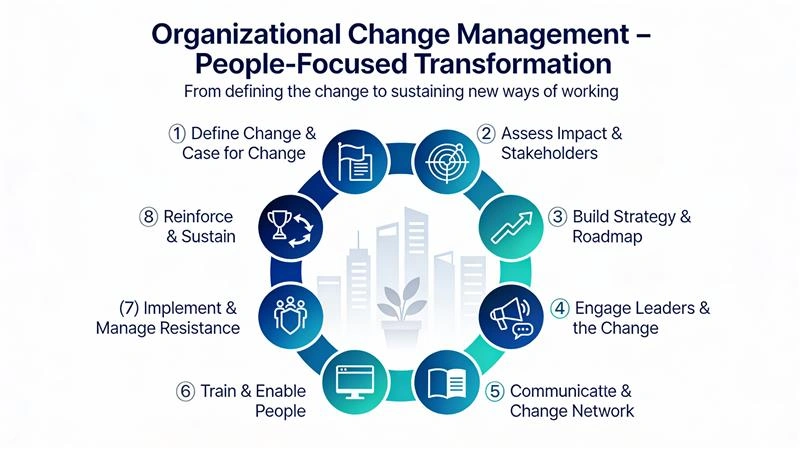
Structured Methodology
Proven 8-step process based on industry best practices
People-Focused Approach
Addresses human factors and behavioral aspects of change
Business Continuity
Ensures operations continue smoothly during transformation
Measurable Outcomes
Trackable metrics and success indicators at every stage
Comprehensive Change Management Framework
Our structured approach ensures successful transformation from current state to desired future state.
Define the Change and Case for Change
Clearly describe what is changing (processes, org structure, systems, roles) and why it matters in business terms: cost, quality, safety, growth, or compliance.
Key Activities
Assess Impact and Stakeholders
Analyze which functions, sites, roles, and suppliers are affected and how: responsibilities, tools, KPIs, and required skills.
Key Activities
Build the Change Strategy and Roadmap
Decide scope, phases, timelines, and governance for the change, treating it as a project with clear objectives, milestones, and success metrics.
Key Activities
Engage Leaders and Create a Guiding Coalition
Identify executive sponsors and influential line leaders who will actively advocate, allocate resources, and model desired behaviors.
Key Activities
Communicate the Change
Develop a communication plan covering key messages (why, what, when, how it affects me), audiences, channels, and cadence.
Key Activities
Enable People: Training, Tools, and Support
Provide targeted training on new processes, systems, and behaviors using a mix of classroom, e‑learning, job aids, and coaching by people managers.
Key Activities
Implement and Manage Resistance
Roll out the change in pilots or waves, closely monitoring adoption, performance, and issues; adjust plans where friction is highest.
Key Activities
Reinforce, Sustain, and Continuously Improve
Embed the change by updating policies, KPIs, reward systems, and audits so the old way of working is no longer the default.
Key Activities
Frequently Asked Questions
Got questions about our services? Find the answers here.
Coordinate Your Change Journey
Whether you're introducing new ERP systems or shifting to Lean production, let's ensure your people are ready, willing, and able to lead the charge.
