Simultaneous Engineering - DFA & DFM
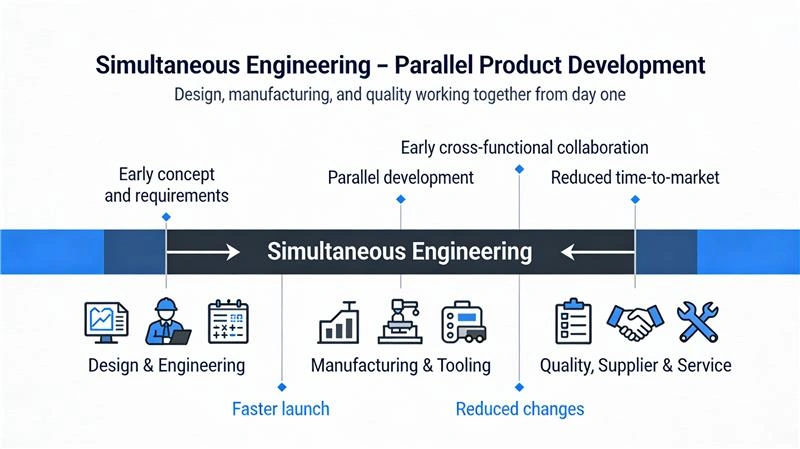
Structures the whole development so major functions work in parallel from day one, with defined checkpoints instead of traditional handovers.
Parallel workflows eliminate sequential bottlenecks
Early issue detection reduces rework and tooling modifications
Integrated reviews ensure manufacturability from start
Joint DFMEA/PFMEA identifies risks before they become issues
Our Approach to Integrated Product Development
Simultaneous Engineering breaks down traditional departmental silos, enabling design, manufacturing, quality, and supply chain teams to collaborate effectively from the earliest stages of product development.
All stakeholders participate in real-time decision making, reducing misunderstandings and rework.
Parallel workflows compress development cycles while maintaining quality standards.
Early identification and resolution of manufacturing issues before tooling commitment.
Our Engineering Modules for SE
Our simultaneous engineering approach combines multiple disciplines working in parallel to optimize every aspect of your product development.
Evaluating part geometry for optimal tool construction. Analyzing draft angles, wall thickness, and potential sink marks.
Optimizing component count and assembly sequence to reduce production time and labor costs.
Identifying complex undercuts that require sliders or lifters, and optimizing parting lines for aesthetic compliance.
Comprehensive draft analysis to ensure parts eject cleanly without deformation or surface damage.
Why Simultaneous Engineering?
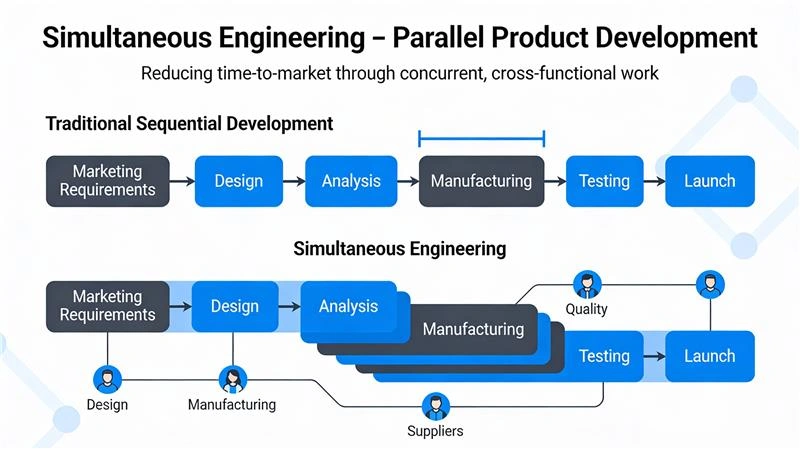
Traditional sequential engineering creates silos and delayed feedback loops. Our approach integrates design, manufacturing, quality, and supply chain expertise from the beginning, ensuring optimal outcomes.
Real World Impact
Discover how Digital Twins & Simultaneous Engineering reduced commissioning time by 60%.
View Digital Twin StudySE Implementation Across Industries
Our Simultaneous Engineering approach integrates every phase of product development, ensuring manufacturability is built into the design from day one.
Body panels, interior trim, lighting systems, powertrain components
Housings, enclosures, structural components, thermal management
Housings, disposable components, surgical instruments, diagnostic equipment
Machine covers, panels, structural supports, protective housings
Our 7-Step SE Implementation Process
Our structured approach ensures all critical functions work in parallel from day one, with defined checkpoints instead of traditional handovers.
Step 01: Cross-functional team setup
Form a core team with design, CAE, manufacturing, quality, purchasing, and key supplier/tooling members from the start. Define shared project goals (cost, timing, quality, performance) and communication cadence so decisions are made jointly, not in silos.
Step 02: Early requirements and concept co-creation
Collect customer, marketing, legal, safety, and manufacturing requirements together, building a single, agreed requirement baseline. Generate and screen concepts with manufacturing and quality present, so design, process, and cost constraints are built in from the first sketches.
Step 03: Parallel design, analysis and process planning
Run 3D design, CAE/FEA, DFM/DFA reviews, and process layout (tooling, fixtures, line concepts) in parallel with frequent short loops, not big gates. Update CAD models and process concepts together so changes in one domain (design or process) are reflected immediately in the others.
Step 04: Integrated risk and feasibility reviews
Conduct joint DFMEA/PFMEA sessions where design and manufacturing engineers assess risks at the same time and define mitigations early. Validate feasibility (tolerances, tooling, assembly, logistics) continuously instead of waiting for a late 'industrialization' phase.
Step 05: Concurrent prototyping and industrialization
Build virtual and physical prototypes while process trials, jig/fixture design, and supplier tooling development are already underway. Use prototype feedback to refine both product and process in the same loop, reducing rework and launch issues.
Step 06: Pre-launch validation and ramp-up
Execute product validation (functional, durability, compliance) and process validation (PPAP, capability, run-at-rate) in an integrated plan. Cross-functional teams support ramp-up, quickly closing issues because design, manufacturing, and suppliers are already aligned.
Step 07: Continuous feedback and improvement
Capture lessons learned across design, process, quality, and supply chain, and feed them back into standards and next-generation projects. Maintain the cross-functional mindset beyond SOP to keep improving cost, quality, and lead time during mass production.
Sequential vs Simultaneous Engineering Comparison
See the difference between sequential handoffs and integrated parallel development
Sequential Engineering
Integrated SE Solutions
Frequently Asked Questions
Got questions about our services? Find the answers here.
Explore Related Engineering Services
Discover other precision engineering solutions that complement Simultaneous Engineering to deliver world-class product excellence.
Ready to Implement SE with MG Techworks?
Our simultaneous engineering approach provides a detailed roadmap for your tooling partners, eliminating ambiguity and ensuring manufacturing success from day one.
