CAD-Centric Digital Twin
A CAD‑centric digital twin connects your 3D models with simulation, manufacturing, and live operational data so every decision is made on a single, trusted source of truth.
Reduced Prototyping Costs
Fewer physical prototypes needed
Faster Time-to-Market
Accelerated design and validation cycles
Predictive Maintenance
Accuracy in failure prediction
Quality Improvement
Design accuracy and consistency
4-Phase CAD-Centric Digital Twin Process
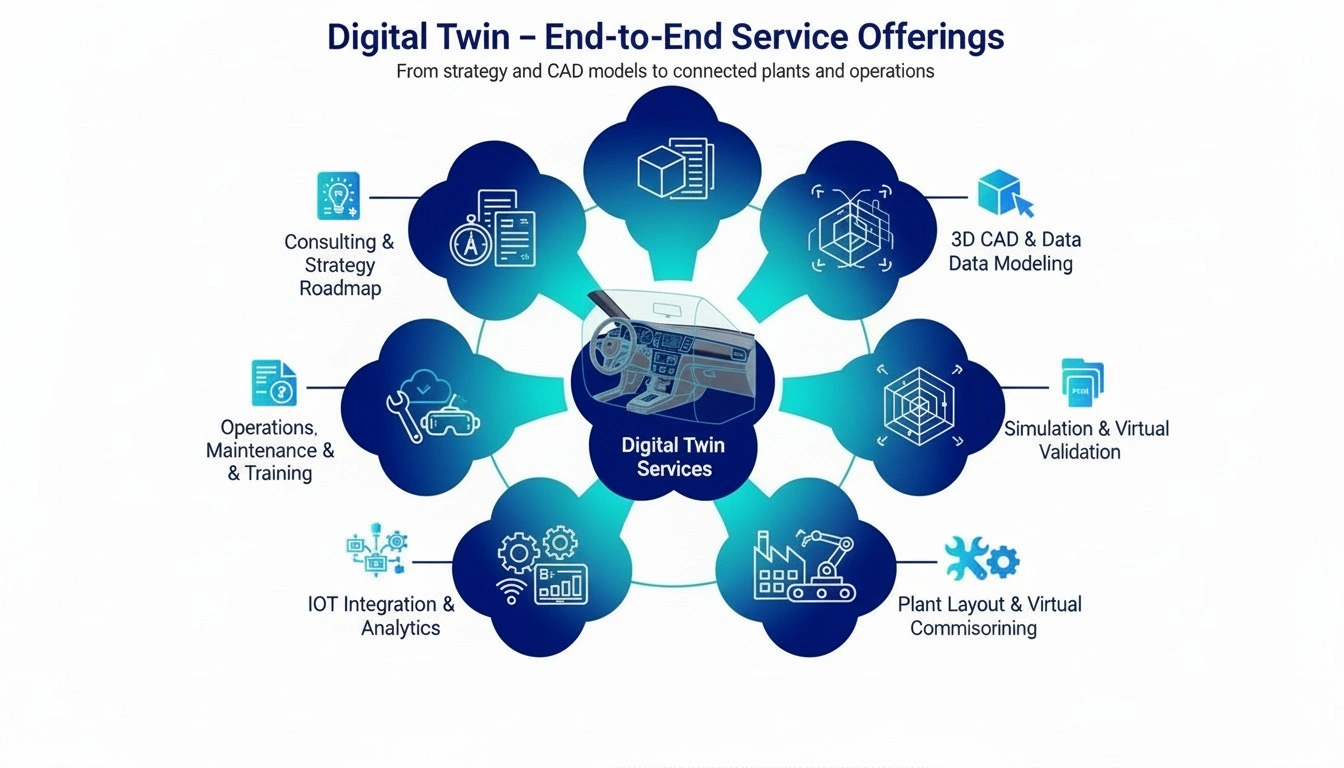
A digital twin in the CAD domain starts from high‑fidelity 3D models and extends them with physics, process, and sensor data across the full lifecycle.
Living Virtual Representation
This creates a living virtual representation of your product or system that mirrors the behavior of the real asset in design, manufacturing, and operation.
Single Source of Truth
All stakeholders work from the same accurate, up-to-date model
Real-time Insights
Live data integration for immediate decision-making
Predictive Capabilities
Anticipate issues before they occur in the physical world
Digital Twin Deployment Roadmap
Our structured approach ensures seamless integration from design through operations.
Design & Virtual Prototyping
Engineers build parametric 3D models that embed requirements, constraints, and variant logic as the foundation of the digital twin.
What Happens
Virtual prototypes are used for packaging checks, kinematics, clash detection, and early functional validation long before hardware exists.
Key Steps
- Create master CAD models with clear datums, interfaces, and configuration rules
- Link models to requirements and options so one twin can represent many variants
- Run virtual design reviews directly on the twin (sectioning, motion, envelopes)
Benefits
- Fewer physical prototypes and faster design loops, cutting development time and cost
- Better design quality, because issues in packaging, clearances, and interfaces are found early
Simulation & Performance
The CAD‑based twin feeds structural, thermal, fluid, and multi‑body simulations to predict how the product behaves under real loads and conditions.
What Happens
Simulation results are written back into the model as fields, annotations, and design rules, closing the loop between analysis and geometry.
Key Steps
- Generate analysis‑ready meshes and boundary conditions directly from the CAD twin
- Run iterative FEA, CFD, NVH, and motion simulations across the operating envelope
- Use optimization to adjust parameters inside the CAD model
Benefits
- Higher confidence in performance and reliability before tooling or field testing
- Lightweight, cost‑optimized designs that meet all performance targets
Manufacturing & Process Twins
The product twin is extended to represent manufacturing processes such as machining, welding, molding, assembly lines, and plant layouts.
What Happens
Tooling, fixtures, robots, and material flow are modeled so production can be validated and optimized virtually.
Key Steps
- Derive CAM, NC programs, and toolpaths directly from the CAD twin with associativity
- Build assembly line or cell models using the same geometry
- Run throughput simulations to test cycle time and resource utilization
Benefits
- Reduced ramp‑up risk and fewer line modifications
- Better collaboration between design and manufacturing for right‑first‑time designs
Operations & IoT Feedback
In service, sensor and IoT data from machines or products are streamed into the digital twin to reflect real usage, loads, and degradation.
What Happens
Engineers and operations teams use the twin to understand performance, diagnose issues, and predict failures.
Key Steps
- Map field sensors to locations and features in the CAD twin
- Aggregate, clean, and visualize live data on top of the 3D model
- Use analytics or AI models for predictive maintenance
Benefits
- Higher uptime and lower maintenance cost through predictive service
- Continuous design improvement based on actual operating conditions
Digital Twin Visualization
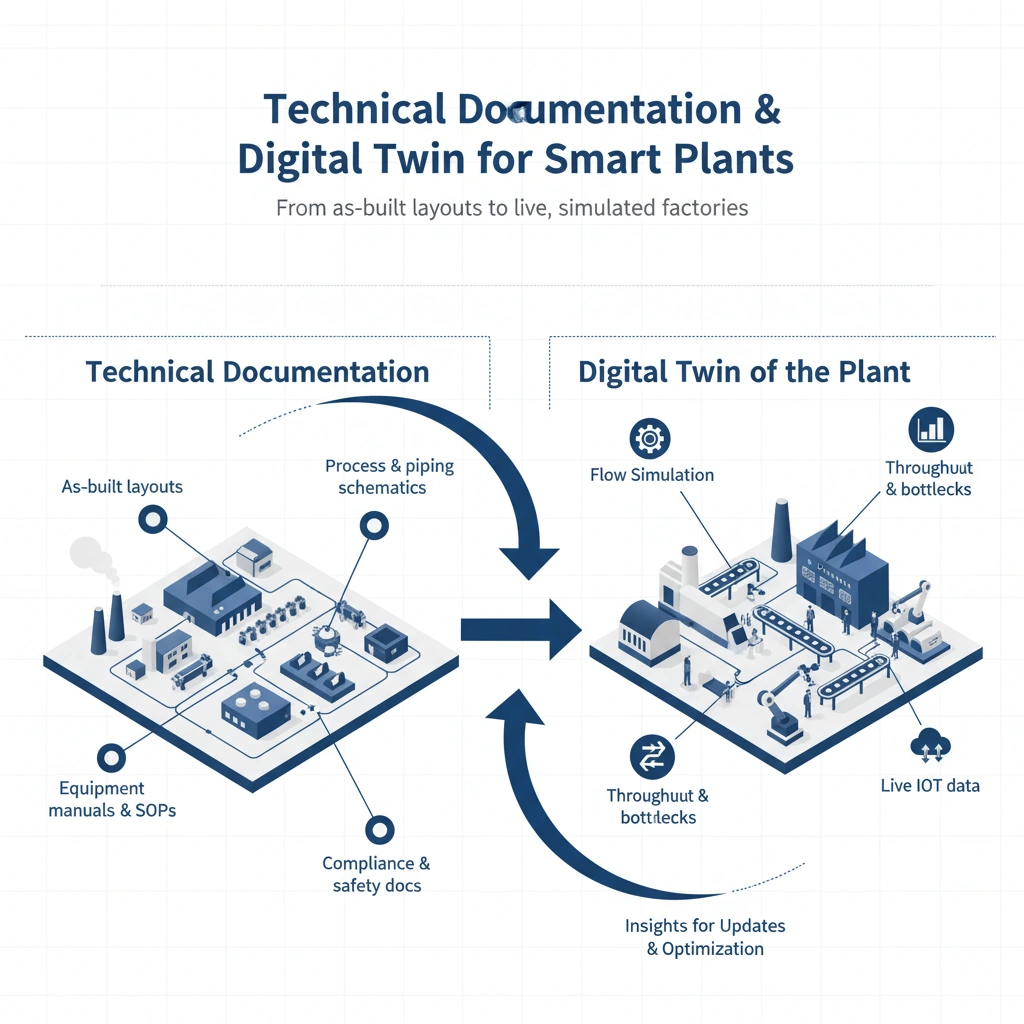
See how technical documentation integrates with plant digital twins for layout and simulation optimization.
Technical Documentation + Digital Twin Integration
Combining layout, simulation, and operational data for comprehensive plant optimization
Our Full-Scale Digital Twin Solutions
We provide end-to-end solutions for creating and maintaining your digital twin ecosystem.
Digital Twin Integration
Creating dynamic digital replicas of physical assets to monitor performance, simulate scenarios, and predict maintenance needs.
Interactive Assembly Manuals
Step-by-step 3D visual instructions that guide shop floor technicians through complex assembly processes with clarity.
MBOM Development
Translating engineering designs (EBOM) into manufacturing-ready structures (MBOM) for seamless production execution.
Asset Lifecycle Documentation
Centralized maintenance and operation documentation that stays updated throughout the product's functional lifespan.
Industry Applications
Digital twins are transforming operations across multiple industries with tailored applications.
Business Impact
Implementing digital twins delivers measurable business value across key performance indicators.
Frequently Asked Questions
Got questions about our services? Find the answers here.
Step Into the Future of Operations
Whether you need interactive spare part catalogs or a full-scale digital twin of your assembly line, our specialists are ready to architect your digital future.
