Value Stream Mapping
Expose losses in time, inventory, and coordination across manufacturing engineering and production in automotive environments.
Benefits of Value Stream Mapping
Lead Time Reduction
Shorter order‑to‑delivery lead times through optimized flow
WIP Inventory Reduction
Lower work-in-progress and clearer logistics
Quality Improvement
Better model‑mix handling and reduced rework
Collaboration Enhancement
Improved cross-functional teamwork and shared vision
Automotive Value Stream Mapping
Value stream mapping in an automotive environment focuses on how a vehicle, subassembly, or component flows from raw material to finished car, exposing losses in time, inventory, and coordination across manufacturing engineering and production.
Key Metrics Analyzed
Success Story: 90% Efficiency Gain
See how we transformed a Tier-1 wiring harness plant using these exact VSM methodologies.
Read VSM Case Study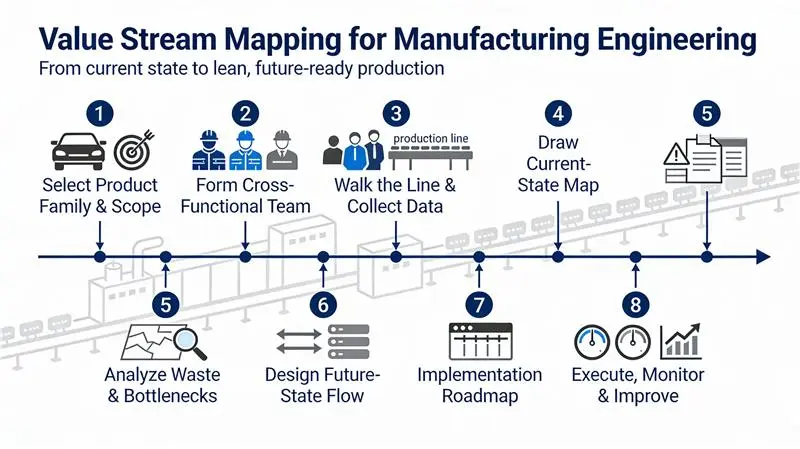
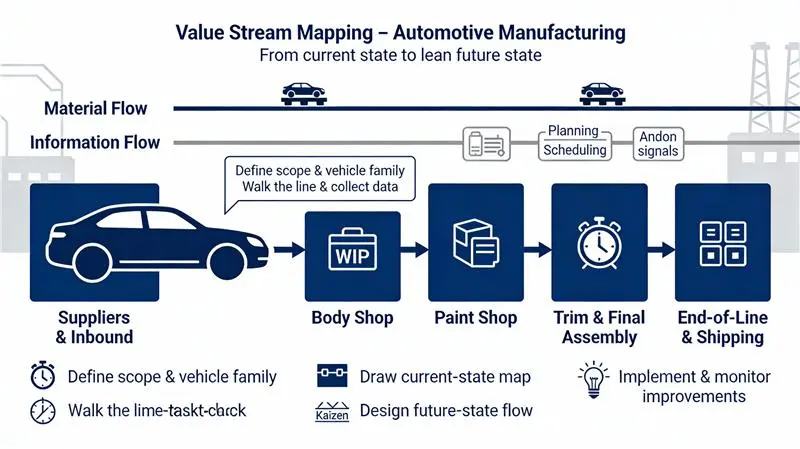
VSM Process Flow for Automotive Manufacturing
Our systematic approach ensures comprehensive analysis and optimization of your automotive manufacturing flow.
Cross-Functional Insights
Stronger collaboration across engineering, production, logistics, and suppliers
Waste Elimination
Identify and eliminate seven types of manufacturing waste
Continuous Improvement
Living blueprint for ongoing improvements in the automotive plant
Predictable Operations
More stable, predictable lines, reducing firefighting for manufacturing engineering and operations
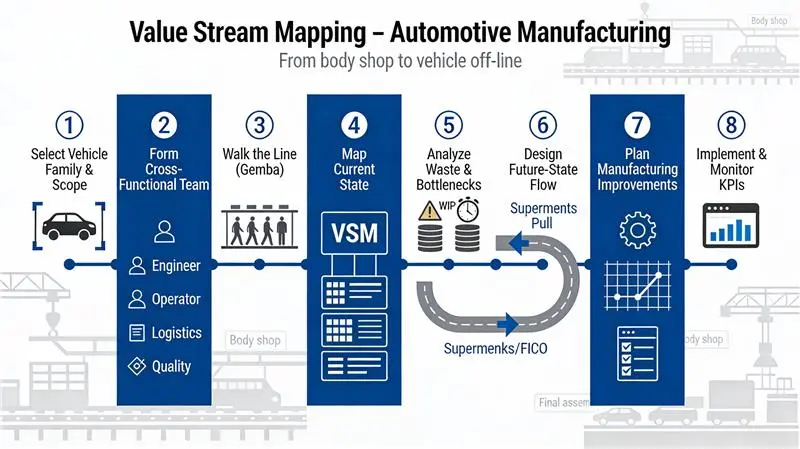
8-Step Automotive VSM Process
Our structured methodology ensures comprehensive analysis and sustainable improvements in your automotive manufacturing operations.
Choose the Vehicle Family and Scope
Select a representative product family such as an instrument panel, door, or powertrain variant, and define the scope from body‑shop input or supplier receipt to vehicle off‑line.
Clarify customer demand (takt time), model mix, and target plant area so the map covers all critical steps but stays manageable.
Key Activities
Build a Cross-Functional Plant Team
Include manufacturing engineers, process planners, line supervisors, logistics, maintenance, quality, and supplier development to capture the full value stream.
Nominate a facilitator who understands lean and automotive standards (e.g., layering of body, paint, assembly) to keep the discussion structured.
Key Activities
Go to Gemba: Walk the Line
Physically follow the flow: incoming parts and modules, kitting, body‑shop welding cells, paint shop, trim/chassis/final assembly, and end‑of‑line testing.
Record cycle times, changeovers, uptime, shift patterns, WIP between stations, buffer sizes, rework loops, and how information is triggered (broadcast schedule, andon, kanban).
Key Activities
Draw the Current-State Map for the Vehicle
Map upstream suppliers, in‑plant logistics (receiving, supermarket, line‑side delivery), and every major process block (e.g., framing line, sealer, paint ovens, IP marriage, wheel mounting).
For each block, create a data box: operators, cycle time, uptime, changeover, scrap, batch size, and container type; add an information layer showing how the production plan moves from planning to lines.
Key Activities
Analyze Waste in Automotive Terms
Identify imbalances to takt time, long changeovers at model‑mix points, excess WIP between body, paint, and GA, and quality loops such as rework areas or offline repair zones.
Highlight material handling waste (too many forklifts, long travel paths, poor kitting), as well as information issues like last‑minute schedule changes and frequent expedites.
Key Activities
Design the Future-State Automotive Flow
Define a leveled production plan (heijunka) and choose pacemaker processes (often final assembly or a key module line) that pull demand upstream.
Introduce supermarkets and FIFO lanes between body, paint, and assembly; reduce batch sizes; rebalance stations to takt; integrate standardized work, quick changeovers, and error‑proofing in critical operations.
Key Activities
Create an Implementation Roadmap
Translate gaps into concrete manufacturing‑engineering projects: layout changes, new kitting concepts, line balancing, SMED for tool changes, automation tweaks, and poka‑yoke fixtures.
Prioritize by impact on vehicle lead time, OEE, WIP, and quality, and phase actions so they align with shutdowns or model‑year changes.
Key Activities
Execute, Monitor, and Continuously Improve
Implement changes, update PFMEAs, control plans, and standard work, and track KPIs such as lead time from body‑shop entry to shipping, WIP per zone, and first‑time‑through at end‑of‑line.
Refresh the VSM regularly (e.g., every model year or after major launches) so it becomes a living blueprint for ongoing improvements in the automotive plant.
Key Activities
Proven Automotive VSM Results
Delivering measurable improvements across key automotive manufacturing metrics
Lead Time Reduction
WIP Inventory Reduction
Quality Improvement
Model-Mix Handling
Frequently Asked Questions
Got questions about our services? Find the answers here.
Ready to Optimize Your Automotive Production Flow?
Our manufacturing engineering consultants provide on-site VSM workshops specifically tailored for automotive environments, delivering immediate insights into your production bottlenecks.
