The Need for 3D Tolerance Analysis Software
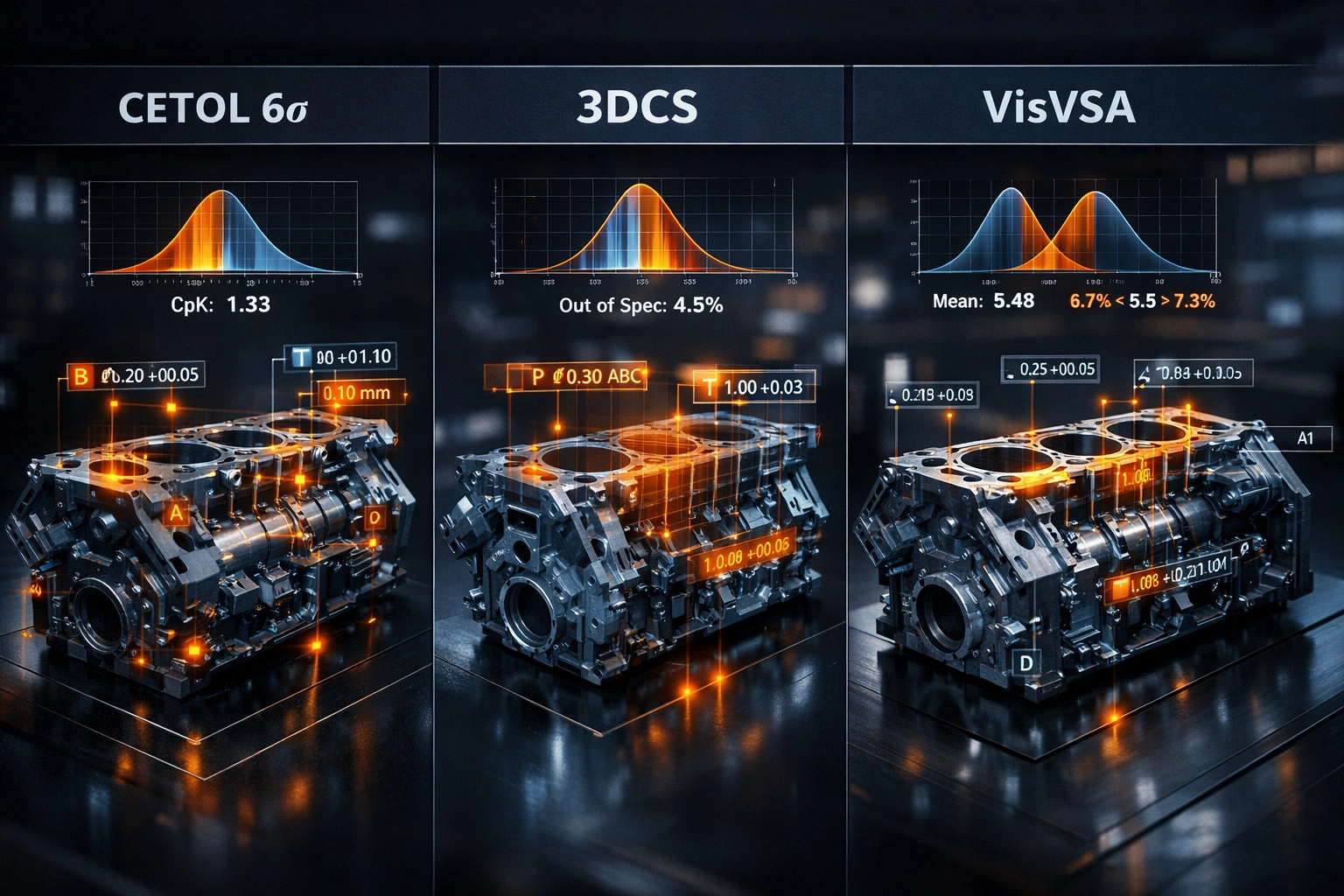
In modern manufacturing, simple 1D stack-ups in Excel are no longer sufficient. To guarantee 6-sigma quality in complex assemblies, engineers must simulate 3D variations. Leading tools perform Monte Carlo simulations to predict how individual part tolerances impact the final assembly gap and flush. But which tool is best?
Top Contenders
1. CETOL 6σ (by Sigmetrix)
A highly popular tool that integrates deeply with major CAD platforms (CATIA, SOLIDWORKS, Creo, NX).
Pros: Excellent CAD integration. It utilizes a unique mathematical formulation that claims to be faster than pure Monte Carlo simulations while maintaining accuracy. Strong focus on sensitivity analysis (identifying exactly which dimension contributes most to failure).
Cons: Steeper learning curve. The interface, while powerful, can be overwhelming for casual users.
2. 3DCS Variation Analyst (by DCS)
Often considered the industry standard in the automotive and aerospace sectors.
Pros: Extremely robust simulation engine. It handles complex kinematics and compliant (flexible) parts very well. Like CETOL, it integrates seamlessly into CATIA, NX, and SOLIDWORKS. Excellent reporting features.
Cons: High cost. Requires significant training to utilize its full potential.
3. VisVSA (Siemens Teamcenter)
VisVSA (Variation System Analysis) is a powerful tool integrated deeply into the Siemens PLM ecosystem.
Pros: Phenomenal for users already operating within Teamcenter and NX. It handles massive assemblies easily and links directly to PLM data.
Cons: Can feel clunky if you are not using Siemens products. Standalone operation is less intuitive than 3DCS or CETOL.
Conclusion and Recommendations
For general product design with strong CAD integration: CETOL 6σ.
For complex automotive/aerospace kinematics: 3DCS Variation Analyst.
For Siemens PLM unified enterprises: VisVSA.
*Don't want to invest $20k+ in software and training?**
MG Techworks offers expert 3D Tolerance Stackup and Tolerance Stack-up Analysis services. We buy the software and provide the expertise, delivering you the final actionable reports.