Lean Training
Build the capability to remove waste, improve flow, and create a culture of continuous improvement across manufacturing and engineering.
Benefits of Lean Training
Lead Time Reduction
Improved flow and reduced waste
Productivity Improvement
Increased efficiency and output
Quality Enhancement
Reduced defects and rework
Cost Reduction
Lower operational costs
Success Story: Lean Transformation
Discover how our Lean training program led to a 25% productivity increase in just 6 months.
9-Step Lean Transformation Process
Our comprehensive approach combines skill building with practical implementation to deliver sustainable results across your organization.
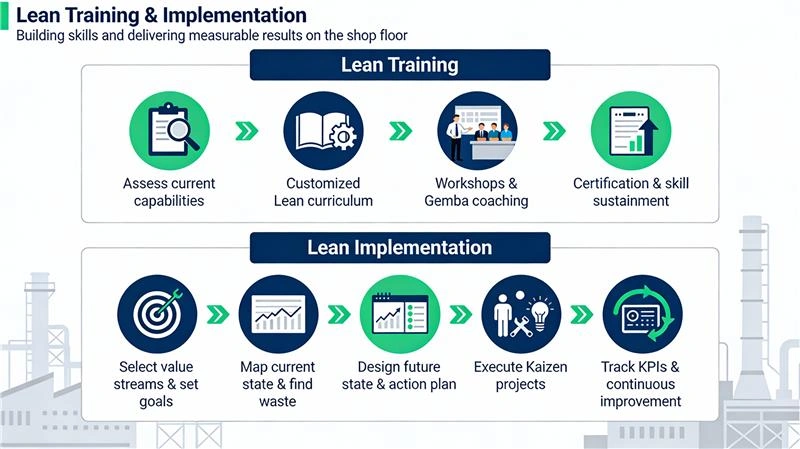
Complete Lean Transformation Framework
Combining training, implementation, and continuous improvement for sustainable results
Developing Lean Capabilities Across Your Organization
Assess Current Capabilities
Start with a diagnostic of existing processes, KPIs, and team skills using interviews, Gemba walks, and data review to understand how work really flows.
Key Activities
Customized Lean Curriculum
A tailored curriculum is created around core Lean principles (value, value stream, flow, pull, perfection), wastes, 5S, VSM, SMED, Kanban, and standardized work.
Key Activities
Workshops and Gemba Coaching
Interactive classroom sessions are combined with on‑the‑floor exercises where teams apply tools directly to live processes.
Key Activities
Certification and Skill Sustainment
Participants complete projects, knowledge checks, and practical assessments to demonstrate mastery.
Key Activities
Practical Deployment for Measurable Business Outcomes
Select Value Streams and Set Goals
Together with leadership, high‑impact value streams are selected, and clear targets are set for lead time, OEE, WIP, quality, and delivery.
Activities
Map Current State and Find Waste
Teams create current‑state value stream maps showing material and information flow from supplier to customer.
Activities
Design Future State and Action Plan
Using Lean principles, a future‑state map is designed with improved flow, right‑sized buffers, pull systems, and leveled scheduling.
Activities
Execute Kaizen Projects
Cross‑functional teams run focused Kaizen events on topics such as 5S, setup reduction, line balancing, material presentation, and error‑proofing.
Activities
Track KPIs and Drive Continuous Improvement
Visual dashboards and daily management routines make performance transparent.
Activities
Core Lean Tools & Methodologies
Proven methodologies that drive sustainable improvements across your operations.
5S System
Sort, Set in order, Shine, Standardize, Sustain for a high-performance workplace.
Key Benefits
Value Stream Mapping
Visualize material and information flow to expose waste and design future state.
Key Benefits
SMED
Single Minute Exchange of Die - reducing changeover times to increase flexibility.
Key Benefits
Standardized Work
Document best practices and create consistent, repeatable processes.
Key Benefits
Kanban System
Visual scheduling system that controls the logistical chain from production.
Key Benefits
PDCA Cycle
Plan-Do-Check-Act methodology for continuous improvement and problem-solving.
Key Benefits
Frequently Asked Questions
Got questions about our services? Find the answers here.
Explore Process Excellence Solutions
Combine Lean Training with our other optimization services to achieve total operational excellence and sustainable growth.
Ready to Transform Your Operations?
Achieve world-class operations and transform your facility into a showcase of Lean excellence. Let's start with a comprehensive skill gap analysis today.
